
Skip to content
Bug Ai
Free tool · no sign-up

Is This Spider Dangerous?

Check the 20 spiders people find most in the US, with how risky each bite really is.

Show

Showing 20 of 20 spiders, most dangerous first.

Black widow

Latrodectus mactans, L. hesperus, L. variolus

Level 4 of 5 · Dangerous

Looks like
Shiny black with a round belly and a red hourglass underneath.
Size
Body 8–13 mm, about 1.5 in with legs
Where
Whole US, most in the South and West. Woodpiles, sheds, garages, meter boxes.
The bite
A pinprick, then cramps and muscle pain spreading from the bite within hours, often with sweating and nausea. Deaths are very rare, but see a doctor: severe pain can be treated.
Brown recluse

Loxosceles reclusa

Level 4 of 5 · Dangerous

Looks like
Plain tan with a dark violin on the front, six eyes in three pairs, smooth legs.
Size
Body 6–12 mm, about 1 in with legs
Where
South and Midwest, Texas to Ohio. Boxes, closets, attics, shoes left on the floor.
The bite
Often painless at first. Most bites heal on their own, but some become a sore that spreads and darkens over days. See a doctor if it blisters, darkens or spreads, or with fever.

Brown widow

Latrodectus geometricus

Level 3 of 5 · Take care

Looks like
Tan to brown with an orange hourglass; egg sacs covered in little spikes.
Size
A little smaller than a black widow
Where
Warm states: Southern California, Texas, the Gulf Coast and Florida.
The bite
Usually only pain and redness. Its venom is like a black widow's but it injects much less. See a doctor if cramps start.

Yellow sac spider

Cheiracanthium inclusum

Level 2 of 5 · Mild

Looks like
Pale yellow or green with darker jaws and foot tips. No web.
Size
Body 5–10 mm
Where
Whole US. Hunts at night and often wanders onto walls and ceilings.
The bite
Painful, with redness and swelling, sometimes a small sore that heals in a week or two. Often blamed for recluse bites.

Hobo spider

Eratigena agrestis

Level 2 of 5 · Mild

Looks like
Brown with a chevron pattern on the belly; funnel web at ground level.
Size
Body 7–14 mm
Where
Pacific Northwest: Washington, Oregon, Idaho, Utah, Montana.
The bite
Can hurt like a pin prick. It was once blamed for wounds like a recluse's, but later studies found its bite is not dangerous.

Wolf spider

Family Lycosidae

Level 2 of 5 · Mild

Looks like
Hairy, grey-brown and striped; eight eyes, two big ones facing forward.
Size
Body 10–35 mm
Where
Whole US. Hunts on the ground and wanders indoors in autumn.
The bite
Bites only if trapped or handled. Hurts like a bee sting, with some swelling. Not dangerous.

Dark fishing spider

Dolomedes tenebrosus

Level 2 of 5 · Mild

Looks like
Large, grey-brown with dark W-shaped marks on the belly.
Size
Body 15–26 mm, up to 3.5 in with legs
Where
East and South, in woods, near water, on docks and in basements.
The bite
Big fangs and a bite like a bee sting, but not dangerous. It runs rather than bites.

Huntsman spider

Heteropoda venatoria

Level 2 of 5 · Mild

Looks like
Large, flat and tan, with legs that spread sideways like a crab's.
Size
Body about 25 mm, up to 5 in with legs
Where
Warm states: Florida, the Gulf Coast, Southern California, Hawaii.
The bite
Shy, but a bite can hurt and swell for a few hours. Not dangerous.

Texas brown tarantula

Aphonopelma hentzi

Level 2 of 5 · Mild

Looks like
Big, hairy and dark brown; slow.
Size
Body about 2 in, 4 in with legs
Where
Texas, Oklahoma, Kansas, Louisiana, New Mexico. Males wander in autumn.
The bite
Rarely bites; a bite feels like a bee sting. The hairs it flicks from its belly can itch and irritate eyes.

False black widow

Steatoda grossa

Level 2 of 5 · Mild

Looks like
Round, purple-brown to black, with no red hourglass.
Size
Body 6–10 mm
Where
Most of the US, often inside homes.
The bite
May hurt, with mild pain or sweating near the bite for a day or two. Far milder than a black widow's.

Woodlouse spider

Dysdera crocata

Level 2 of 5 · Mild

Looks like
Red-orange legs and front, shiny cream-grey belly, big fangs.
Size
Body 11–15 mm
Where
Most of the US, under rocks, logs and pots where woodlice live.
The bite
Its large fangs can break skin and the bite hurts and itches, but it is not dangerous.

Bold jumping spider

Phidippus audax

Level 1 of 5 · Harmless

Looks like
Compact and furry, black with white spots and shiny green jaws. Jumps.
Size
Body 8–15 mm
Where
Whole US, on walls, fences, windows and plants.
The bite
Very rarely bites, and then only a pinch. Curious and harmless.

Common house spider

Parasteatoda tepidariorum

Level 1 of 5 · Harmless

Looks like
Small, round, brown-grey and mottled; messy cobweb.
Size
Body 4–6 mm
Where
Whole US, in corners, windows and garages.
The bite
Almost never bites. Harmless, and it catches pests.

Cellar spider (daddy longlegs)

Pholcus phalangioides

Level 1 of 5 · Harmless

Looks like
Tiny body and very long thin legs; shakes its web when touched.
Size
Body 7–8 mm, legs up to 2 in
Where
Whole US, in basements, ceilings and corners.
The bite
Harmless. The story that it is the most venomous spider but cannot bite is false on both counts.

Yellow garden spider

Argiope aurantia

Level 1 of 5 · Harmless

Looks like
Black and yellow, in a big orb web with a zigzag down the middle.
Size
Body 19–28 mm
Where
Whole lower 48, in gardens and tall grass in late summer.
The bite
Bites only if grabbed, like a mild bee sting. Harmless, and it eats garden pests.

Spotted orb weaver

Neoscona crucifera

Level 1 of 5 · Harmless

Looks like
Round, brown to orange, with banded hairy legs. Builds a big web at dusk.
Size
Body 7–17 mm
Where
East and Midwest, on porches, eaves and shrubs.
The bite
Rarely bites. Harmless.

Spinybacked orb weaver

Gasteracantha cancriformis

Level 1 of 5 · Harmless

Looks like
White or yellow hard shell with six red or black spikes.
Size
Body 5–9 mm, wider than long
Where
Southern US: Florida, the Gulf Coast, Texas, California.
The bite
Rarely bites; at most a mild pinch. Harmless.

Grass spider

Agelenopsis spp.

Level 1 of 5 · Harmless

Looks like
Brown with two dark stripes on the head and a sheet web with a funnel.
Size
Body 10–20 mm
Where
Whole US, in lawns, hedges and window wells.
The bite
Shy and fast; it runs into its funnel. Bites are rare and mild.

Goldenrod crab spider

Misumena vatia

Level 1 of 5 · Harmless

Looks like
White or yellow, front legs held out like a crab's.
Size
Body 6–10 mm
Where
Most of the US, waiting on flowers.
The bite
Too small to bite most people. Harmless.

Southern house spider

Kukulcania hibernalis

Level 1 of 5 · Harmless

Looks like
Males tan and long-legged, females dark and velvety. Eight eyes close together.
Size
Body 13–19 mm
Where
The South, Texas to Florida and up the East Coast, around windows and eaves.
The bite
Rarely bites. The males are often mistaken for brown recluses but have no violin mark.

Most spiders are harmless to people

Almost every spider has venom, but very few can hurt a person. In the US only two groups are medically significant: the widows (black and brown widow) and the recluses (brown recluse and its desert relatives). Everything else on this list causes at most a bite like a bee sting.

Most "spider bites" seen by doctors turn out to be something else, often a skin infection. If you did not see the spider bite you, keep an open mind and watch the spot. Our bug bite identifier helps narrow it down.

When to see a doctor

  • Cramps, sweating or nausea after a bite: a widow bite can do this.
  • A bite that blisters, darkens or keeps spreading after a day.
  • Fever, chills or a red streak running from the bite.
  • A child or an older adult bitten by a widow or a recluse. In the US, poison control is 1-800-222-1222.

Not sure which spider you have?

Take a photo from a safe distance and try the free bug identifier. It names the spider and gives the same danger level. Never pick up a spider to photograph it.

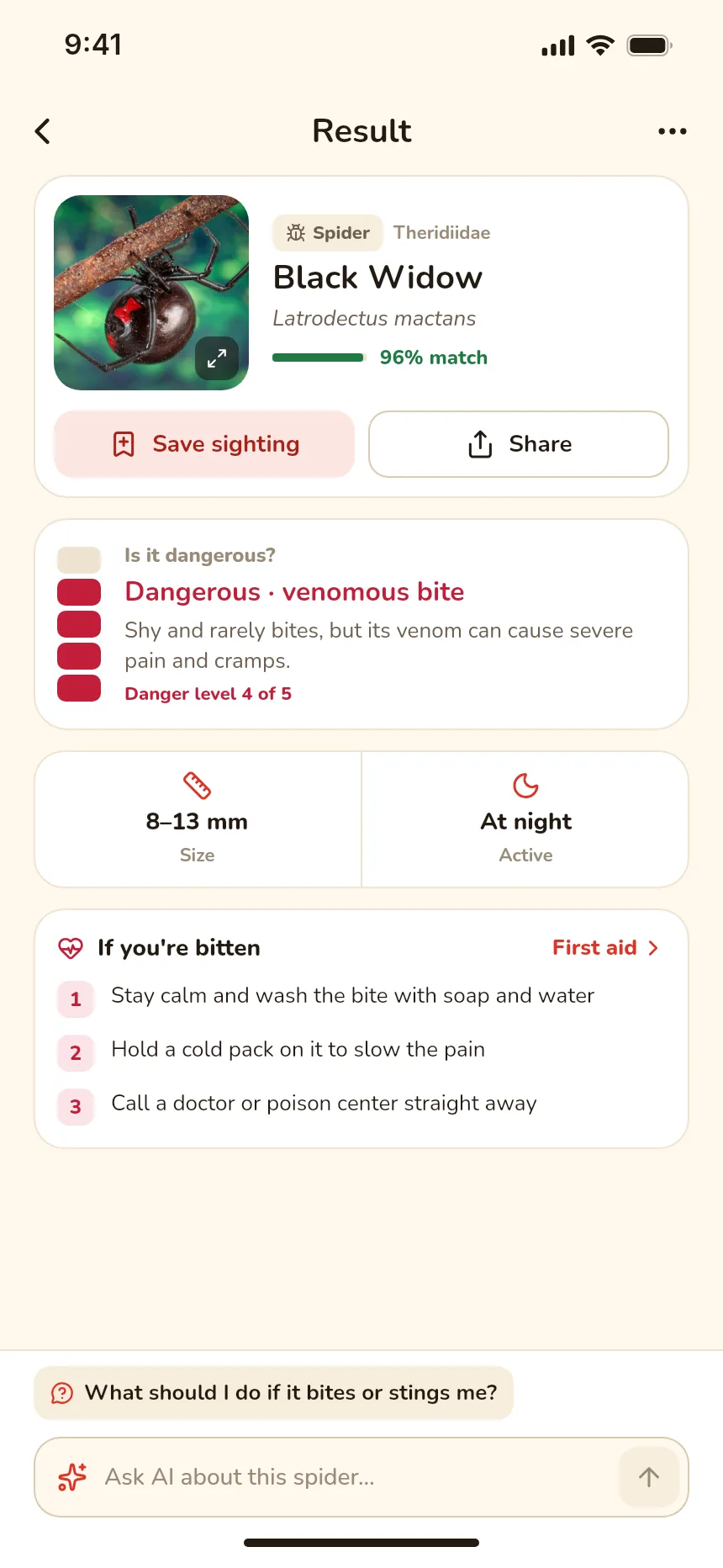
Is it dangerous? Snap it.

Bug Ai names the species and rates the danger from 1 to 5.

Bug Ai app screen

FAQ

Questions people ask

Short answers about this free tool.

What is the most dangerous spider in the US?

The black widow. Its venom affects the nerves and can cause severe cramps, though deaths are very rare today. The brown recluse comes close: a small share of its bites cause a spreading sore.

Are wolf spiders dangerous?

No. A wolf spider bite hurts like a bee sting but is not dangerous. They bite only when trapped or handled.

How do I tell a brown recluse from other brown spiders?

Look for six eyes in three pairs, a plain tan body with a dark violin on the front, and smooth legs with no stripes or spines. Most brown spiders people find are wolf, grass or southern house spiders.

Is the daddy longlegs the most venomous spider?

No. That story is a myth. Cellar spiders are harmless, and their bite does almost nothing to people.